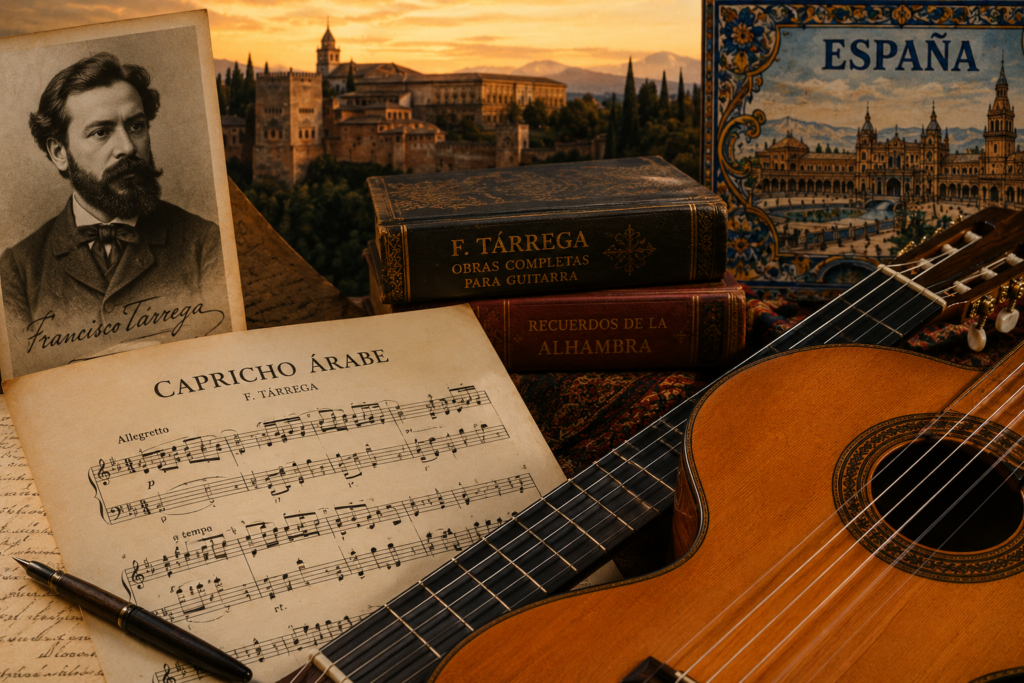
Analysis of Capricho Arabe by Francisco Tarrega and his approach to the Arabic Maqam Music
 By
/ May 30, 2026
By
/ May 30, 2026 Introduction and context
Capricho Arabe is a well-known guitar piece by Spanish guitarist and composer Francisco Tarrega (1852-1909). The piece is dedicated to his friend, composer Tomás Bretón. It was composed after a long journey through Andalusia and North Africa.
Tárrega is always admired among guitar lovers for two reasons: not just his fabulous compositions, but also because he invented the footstool to maintain a stable posture for the guitar. Additionally, a part of his composition, Gran Vals (Nokia Vals), has been used as a ringtone for Nokia phones.
His music is influenced by other composers of the time. “The music of Berlioz, Chopin, Schumann, Schubert, and other Romantic composers influenced the music in Tárrega’s life. The nationalistic music found in many of the Romantic composers also is evident in Tárrega’s music”1. Specially, the Phrygian mode and the use of Arabic maqam musical elements depict the use of nationalistic music.
I would like to analyze Capricho Arbabe in this essay and later discuss how he approaches Arabic Maqam Music.
1 Pham T Thanh, The Story Of Capricho Arabe, 2013 p. 8
Analysis of the Capricho Arabe
The Structure of the piece
The piece consists of four main sections: D minor (bars 1-34), F major (bars 35-44), D major (bars 45-60), and back to the first section on D minor. This is quite interesting way of using keys which is the relative and parallel key relativity. First, he uses the minor to relative major combination, which is D minor to F major. Later, he uses the parallel key combination of D major to D minor. In the middle, he employs an indirect third relation that is F Major to D Major.
“The first melody, being in D minor, is charged with melancholy and sadness that tugs at the heart. The second theme, which modulates to F major, and the third theme in D major, gives us but a brief respite and a momentary sense of optimism, climaxing into the inevitable pain of the first theme in D minor, challenging the performer to tell the same story one more time but from a different space in your heart.”2

Figure 1
It is obvious that Tarrega did not reach the conventional structure here because he did not use the credential key relation, namely subdominant and dominant (G minor and A major). There are some romantic compositions which used the same kind of key structure at that time. For instance, Shubet’s Godowsky – Moment musicaux Op 94 No. 3 (F minor to Ab major and goes F major).
2 Monte del Adam (checked:29th May,2024) www.learnavel.com/lessons/classical/guitar/capricho-arabe
The main sections of the piece

Figure 2
The piece begins with an introduction (bars 1-12) that harmonically prolongs the dominant (V) of D minor. This 12-bar introduction emphasizes the dominant to draw more attention. This introduction is 12 bars long, which is unbalanced.
“The introduction sets the mood with the tempo and meter until measure 13, where the meter becomes duple. Cooke best puts the duple meter as a “wooden, slow march.” One possible interpretation could be to make the first minor section adagio, which enables the listener to have a reference of the tempo. Then, the performer could move to slightly quicker pace in the major section and multiply the effect of pleasure. A notable difference in character occurs when the key changes from D minor to D major. This transition area has material the performer may wish to bring out. For the final return of the first theme in D minor, a contrast in tempo would add a dramatic and a somber affect to the music.”3
There is a bridge like two bars of ostinato in bars 13-14 which introduces a new time signature of 4/4. It is like a slow march melody, as Thanh said above. The main melody repeats the base notes from bars 15 to 19.

Figure 3
3 Pham T Thanh, The Story Of Capricho Arabe 2013 p. 11-12
This bridge appears again exactly before the A1 section (bar 25), but this time the bass notes have been changed and there is no continuation. This will guide to be a tempo after the accelerando of bars 21 and 22. (see attached score)

Figure 4
When looking at the A sections (A, A1, A2), they are longer than the B section. (Figure 5)
A_____________B___ A____
Figure 5
As a conclusion, the form of ‘Capricho Árabe’ is in ternary form, which is a three-part musical structure consisting of an opening section (A), a contrasting middle section (B), and a repetition of the first section (A). Although the piece follows an ABA structure, it can also be perceived as a theme with variations.
If we go further with form analysis, I could see a sentence on bars 15-18. However, as the ending of this sentence is on dominant on bar 18, I could say it is like a period with imperfect ending. This character can also be seen from 45 to 48. However, this time with a little bit of similarity. The first idea of (bars 45 to first two beats of 46) is similar to bar 49 to first two beats of bar 51, the rest is like prolongation of the dominant which ends in 52 with the open cadence.
Motivic development
The motives in the piece are not too complicated. The ostinato motives in bar 13 (figure 7) is the most used one in this piece, but it is sometimes ornamented. This motif could be named motif A. (Figure 6)

Figure 6 (motif A)

Figure 7 (motif A on the bridge)
However, the motif A appears mostly in different textures on the melody. The first and second crotchet notes have changed to two notes above the base instead of rests, and there were two notes instead of three on the second and third quaver notes (Figure 8). This motif is characterized as a slow march.

Figure 8 (bar 45)
It is quite interesting how he embellishes this motives (figure 7) throughout the piece. The motivic development can be seen on the first two notes of bellow measures.
| Appearance of the motif | Bars |
|---|---|
| Without ornamentation. | 16,19,26,29,35,39,45,51,53 |
| With an acciaccatura (glissando) | 15,17,20,25,27,30,37,47,48,49,55,56,57 |
| With upper mordent | 21,36,38,40,41,46,50,54,58,59 |
| With a chord on the second beat followed by a passing note. | 18,28 |
There is a motif B (Figure 9) that appears almost similar to each other: but in a different way for example, in bars 15 and 35, both motives start with an upper mordent in the second half.


Figure 9 (bars 15 and 35)
And the following motives are in bars 20 and 41, without mordent, and with a descending or ascending melody. (figure 11)


Figure 10 (bars 20 and 41)
Harmonic analysis of the piece
When it comes to harmony, we do not see many complex harmonies in the piece, but there are quite a few interesting points to discuss. The piece begins with an introduction (bars 1-12) that harmonically prolongs the dominant (V) of D minor. Even though the harmonic notes spell out a D5, the ear perceives it as A5 (bar 1). This fifth above the octave harmony note (fret VII harmony) is really more sustained therefore, the lower harmony notes in the first chord of the piece (A, E and A’) will not be muted until the end of the fourth bar, which will also bring the dominant atmosphere. The large dominant introductory area is set up to lead to the low D in bar 13 and take the listener to the first theme. The last chord of bar 4 is Gm, which confirms again the unresolved dominant introduction. The dominant seventh chord in bar 9 is followed by a BbMaj7b5 chord in bar 10. This chord is kind of leading towards an A major in bar 11. The fermata in measure 12 on Bb reminds me of the Phrygian on A major after an eleven bars introductory section.
The ‘A’ section (bars 15-22) begins with a little vamp or ostinato (bars 13-14) which lay on the bass that we hear throughout the piece. These appear sometimes in major and sometimes in minor, and sometimes act as a unifying device. These are noticeable almost everywhere in the piece, such as bars 15-19, 25-29, 35-41, 45-47, and of course in the repeated section on D major (bars 48-70).
The main theme features a four-measure phrase that is decorated on top of a discussed bass line in D minor, supported by simple alternation of tonic and dominant harmony in bars 15-18. The second varied statement of the theme appears for the first time on the subdominant (iv) with the appearance of the commonly used secondary dominant (V/iv in bar 20) before returning to the dominant and the vamp again in bar 23, but this time with an interesting twist. And also Eb the second last note in bar 20 to restate the Phrygian mode on D. We now have four distinct harmonies based on the progression i-VI-bII-V in D minor. The use “Neapolitan Sixth” (N6) chord with its root inversion is interesting, because N6 is usually appears in first inversion (6). It is evoking not only the Phrygian color but also a painful harmony with dissonant jumps.
The ‘A2’ section (bars 35-44) is in the relative major key of F major and is introduced harmonically by modifying the vamp in measure 34 to include a ii-V7 of F major (Gm-C7). Nevertheless, the theme and bass line are also modified a bit in this major key, but the harmony is basically the same, consisting of the simple alternation of tonic and dominant.
There is an unexpected twist at the third beat of bar 32. Here, an E half-diminished seventh chord (Em7♭5), which acts as the ii chord in the key of D minor, transitions into the dominant V chord (A major), articulated through arpeggios. The progression suggests a solution to the tonic, D minor. However, Tárrega creatively interrupts expectations by resolving not to the D minor but rather to its parallel major D major. The E half diminish chords (bars 41 and 42) on dominant pedal also interesting here. (see attached Score)
The ‘B’ section (bars 45-60) as stated is basically a transposed restatement of the ‘A2’ or ‘F’ major section with a bit more repetition. Finally, returning to the restatement of the ‘A’ section or the original D minor material that was started with.
In measure 50, the full diminished seventh chord (D#dim7) seems to set up an expectation for an E major or E minor chord. However, it resolves unexpectedly to A major chord in second inversion (with an E in the bass). The use of B# instead of C natural in the last note of bar 50 allows for more focus on the resolving C# note. The chromatic movement of D# and B# resolving to E and C#, respectively, in the outer voices is confirming the arrival on the dominant chord.


Figure 11 (bars 50 and 51)
At the end, the death march like ostinato (outro- bars 71 and 72) is repeated, followed by the natural and harmonic sound of the D chord.
To sum up, the piece is harmonically simple and conservative for its time. The strong melodic content and use of ostinato bass seem to be appealing in music.
Approach of the Arabic Maqam Music
Capricho Arabe, or the ‘Arabian Caprice’, is Tarrega’s representation of the Arabian influence on Spanish music, bringing back memories of the Moorish occupation of the Iberian Peninsula during the 8th Century AD.
“Tarrega was using Arabe in the sense of “Arabesque,” a musical style of the 1800s featuring very ornamented, punctuated melodies that were loosely evocative of Arabesque architectural ornamentation, over a simple ostinato, all without necessarily invoking Islamic or Arabic musical styles or musical motifs. The melody in Capricho Arabe is not as ornamented as Schumann’s Arabesque, nor approaches the complexity achieved by Debussy, but he achieves it in his own way. That being said, the melody is in Phrygian and resembles Arabic maqam. Spanish music, especially of Andalucia, was influenced by nearly 800 years of Islamic caliphate rule.”4
This is quite interesting because he uses Arabic maqam music in his own way. Specially Phrygian mode with raised and lowered third (Bar 2, C sharp and C natural). The introduction itself is consisting this namely ‘A’ Phrygian with raised and lowered third ‘C’ in F major scale. (Figure 11)

Figure 12 (Bars 1-4)
This Arabic maqam like melody reappear on bars 21 to 22 (figure 13). In addition, this Arabesque like character can be seen again in measures 30, 32, 42, 51, and 52, etc. Therefore, I could say that this Arabic maqam, like Phrygian color, is framing the piece together.
4 Discussion on “What makes Capricho Arabe supposedly sound “Arabic”?” (checked:29th May,2024) www.reddit.com/r/classicalguitar/comments/s0dgz6/music_theory_question_what_makes_capricho_arabe/

Figure 13
In conclusion, Tarrega’s Capricho Arabe is different from the works of Romantic composers at the time. The simple form, harmony, and usage of the Phrygian scale in his own way have made the piece interesting and storytelling. The effect of the piece is clear from the introduction to the end. I would say that this piece tells the story of centuries-old battles between the Arabs and Christians, as well as the struggle for power and survival.
Sources
- Pham T Thanh, The Story Of Capricho Arabe, 2013.
- Monte del Adam, (checked:29th May,2024) www.learnavel.com/lessons/classical/guitar/capricho-arabe
- Discussion on “What makes Capricho Arabe supposedly sound “Arabic”?” (checked:29th May,2024) www.reddit.com/r/classicalguitar/comments/s0dgz6/music_theory_question_what_makes_capricho_arabe/